Showing posts with label connect to principles. Show all posts

Tuesday, July 6, 2010

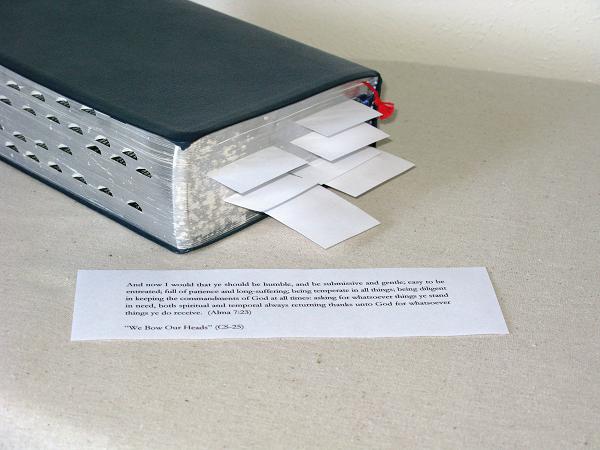
Choose and Review - Song / Scripture Match


Most of our primary songs have scriptures listed at the bottom of the page that correspond to the message of the song. It can be a fun singing time to make the children aware of this.

On a slip of paper, write out one of the scriptures for each song you wish to review. Place the papers in a set of scriptures with the ends poking out. Have a child choose a paper to read and ask the children to guess which song it matches. It might help to have a list of songs on the board. Or, you may prefer to challenge the children to come up with a song from their memory. Pictures, along with the written scriptures, are helpful if you have mostly non-readers.

Tuesday, May 18, 2010

Making Connections to Gospel Principles

In the last several posts I’ve explained some activities that I use to help the children make connections to principles of the gospel during singing time. I also want to emphasize that this process doesn’t have to be formalized in an activity with a title such as “Pick My Pocket,” or “Man the Lifeboats” to be helpful to the children. Just spend some time studying the words and indentifying the principles taught in the songs you are planning to use in singing time. Then you’ll be in a great position to help the children make connections in an informal way also.

You can do this easily just by directing their listening. If you are teaching a song and singing it for the umpteenth time, just say something like “As we sing the song this time, see if you can hear the words that teach us what faith is.” Or, during closing exercises say, “While we sing the prayer song listen for the words in the song that remind us how much our Heavenly Father loves us.” You don’t have to invite responses, just let them think about it.

Whether we design a formal activity or informally direct attention, our efforts to strengthen children with the doctrines of the gospel will bring the spirit into singing time.

Thursday, May 13, 2010

More Ideas for Principle Related Singing Time

The Friend magazine is full of great ideas for a principle-related singing time. Just consider the April 2010 issue. In the article “Helping Feed the Savior’s Lambs” on page 2, President Eyring states a principle when he explains our obligation to nourish each other spiritually. He offers examples of how children can do this. There are several primary songs that teach this principle also. “Lead me, guide me, walk beside me.” (I Am a Child of God CS-2) “To have a friend, you must be a friend, too.” (Friends are Fun CS-262) “He whose heart has joy and song gives joy to others too.” (Be Happy CS-265) “When your heart is filled with love, others will love you.” (Jesus Said Love Everyone CS-61) “I’ll be a sunbeam for him.” (Jesus Wants Me for a Sunbeam CS-60)

I could easily write the song titles on 1-inch wide strips of green paper and roll them up tightly to resemble alfalfa hay pellets. In case you’ve never seen alfalfa pellets, just trust me on this. Find a metal pie plate to use as a feed pan and put the “pellets” in the pan. After introducing the principle as taught by President Eyring, I would have a child choose a song. Challenge all the children to listen as they sing to discover which words teach us to nourish each other.

“Come to the Rescue” on page 10 is a maze activity that is easily overlooked as a singing time, but is actually a really great idea. The maze itself doesn't work well, but the content is great. The principle is still our obligation to strengthen others, but President Monson states it in terms of “manning the lifeboats” and rescuing those who have drifted away.

If I ponder the words of songs listed in the topical index in the Children’s Songbook under “service”, “missionary work” or “example”, I can find songs that will reinforce this principle. I can write questions or case studies for each of the songs as I explained in the last couple of posts. Or I could just list the song title and ask the children to discover the phrase that matches the principle. I’m thinking that posting these on paper life preservers or putting them in a seashell on a tray of sand (think deserted island) would be a cute way to deliver the songs.

“Find the Sheep” on page 34 is also full of possibilites and I’m going to challenge you to think of them. The principle is the same -I think there is a pattern in this issue! What could you do with this page?

Don't miss this fabulous idea from The Crazy Chorister. Melanie used the activity to teach the song "Choose the Right Way", but one could easily insert other primary songs that need to be reviewed. This activity perfectly illustrates how to help the children connect to the principles taught in the songs.

Tuesday, May 11, 2010

The "Everyone Can"


I call this the “Everyone Can”. It is a truly simple aid to use with another review activity that focuses on the gospel principles we learn from the Primary songs.

This activity centers on those principles that are related to the things we do. “Everyone Can” choose the right, make a happy home, keep the commandments, be kind, love their neighbor, etc. I choose a topic and then identify songs with phrases that help teach the principle I wish to teach. Then I write action statements for each of the songs on slips of paper or card strips, throwing in a few negative statements also. The papers go into the “Everyone Can” to be chosen one at a time. If the statement is something that everyone CAN do, I have the children stand up while we sing the song. If the statement is something they should not do, they remain seated.

For instance, if I wanted to teach about honesty I could choose songs from the gospel section of the songbook with phrases that teach this principle. Remember that there are several aspects of honesty, so any number of songs may apply. I might write a statement such as, “An honest child listens to the promptings of the Holy Ghost.” “And with his light I’ll do what’s right Each time I make a choice.” (The Holy Ghost CS-105) Another statement might read, “An honest child tries to make things right when they have made a mistake.” “I will try in all I do and say To live the gospel more each day.” (I Want to Live the Gospel CS-148) “An honest child always tells the truth.” “I’ll form good habits in my youth, to keep my word, to tell the truth.” (I Believe in Being Honest CS-149) “An honest child is courageous.” “Sometimes I am tempted to choose another way.” (Nephi’s Courage CS-120) “An honest child knows he can repent” “And I can be forgiven and improve myself each day.” (When I Am Baptized CS-103) Two or three negative statements add variety. “An honest child quickly blames someone else if an accident happens” “An honest child knows that mistakes don’t count if no one ever finds out.”

Sometimes it’s fun to put inexpensive smiley face stickers in the bottom of the can. I’ll give them out at the end of primary or give them to the teachers to put on the children. The sticker reminds them that everyone CAN be kind, smile, be reverent, choose the right, etc.

The Friend magazine has lately published several quizzes that easily adapt to this kind of singing time. Look at "What Kind of Friend Are You?" on page 28 of the May 2009 issue and you'll see what I mean. The statements in "Choose the Right Words" on page 9 of the January 2010 issue would also make a quick and easy singing time.

Thursday, May 6, 2010

"Pick My Pocket" Choose and Review


"Pick My Pocket" is another review activity designed to help the children make connections to the principles taught in the Primary songs.

Look at the words to the songs you want to review and identify the principles that you would like to emphasize. Design a situation (case study) that will help to illustrate this principle for each of the songs. For example, one of the principles taught in the song “I Know That My Savior Loves Me” is that Jesus loves and blesses children in all ages of history - His character is unchanging. A situation could be written thus. “Some kids at school laughed at the answer Kara gave to a question. As we sing this song, listen for something the song teaches us that would help Kara feel better.” I like the phrases "the love that he felt for his little ones, I know he feels for me." or "wrapped in the arms of my Savior's love, I feel his gentle touch." After singing the song invite the children to share their ideas. Don’t hesitate to share what you had in mind as well. Especially if they “don’t get it.” Briefly discuss and testify of the principle.

Write the situations on slips of paper and put them into the pockets of an apron or some other pocket. The pocket in the picture is simply laminated cardstock with a small paper pocket on the back to hold the slips of paper. I use it sometimes as an alternative to my apron. Invite the children to choose the situations and sing the songs.

Tuesday, May 4, 2010

"Principle Questions" Choose and Review


This review activity is designed to help the children think about the principles of the gospel taught in our Primary songs.

Use the program songs and others that you wish to review. Look at the words to the song and identify the principle you would like to reinforce. There are probably several. Choose one or two for each song. Write a question about the principle that can be answered with the words of the song. Invite a child to choose a question and read it. Have all the children listen for the answer as you sing the song together. Invite their response and then briefly discuss and testify of the principle.

The following are questions and songs that I used a few weeks ago. The picture shows how I set it up. This time I designed the questions to ask why. I wrote them on paper question marks and posted them around the head of a child. I explained to the children that the boy has many questions that we could help him answer and asked them to listen for the words of the song that would give the answer. Emphasize that you aren’t just asking for an answer to the question, but to find how the song answers the question.

“Why should we love one another as Jesus asked?” (Love One Another CS-136) “Why will Jesus guide me when I pray?” (Jesus is our Loving Friend CS-58) “Why should I live worthy to go to the temple?” (I Love to See the Temple CS-95) “Why did Jesus come as a Messiah to conquer evil and death? (I Lived in Heaven CS-4) “Why should I listen to my parents and teachers?” (I Know That My Savior Loves Me) “Why should I follow the prophet?” (Follow the Prophet CS-110) “Why did Heavenly Father send Jesus to earth?” (He Sent His Son CS-34) “Why should I pray?” (Thanks to Our Father CS-20) “Why should I be reverent in Primary?” (Reverently, Quietly CS-26) If your primary is split, you would have the opportunity to create easier questions for the Juniors.

As I mentioned in this post, the children you are working with may not be used to thinking about the songs as they sing. You’ll need to be patient and help them understand what you want them to do. If one week doesn't go well, tweak the activity and give it another chance. Teaching our children to recognize these principles is an important skill. Even the young children can learn how to do this. If you do this kind of thing often enough, the kids will become well trained. Don't hesitate to share your own thoughts and testify.

The activity is very versatile. You can use questions in a sort of random way, singing whichever songs need to be reviewed, or you can design the questions to teach a specific topic such as prayer and then review prayer songs. Or, you could use a more general theme like the happiness we find as we serve others or make right choices and then find the phrases in songs to teach this larger theme.
Thank you for visiting The Children Sing. Check back soon for more LDS Primary Singing Time Ideas!

http://thechildrensing.blogspot.com